

How Body Chemistry Affects Tanning: A Clear Guide

Tanning is defined as a biochemical process in which your skin responses to UV radiation or chemical agents by altering its pigment. How body chemistry affects tanning determines whether you develop a deep golden glow, a faint color shift, or a painful burn. Two distinct systems drive this: UV-triggered melanogenesis inside living skin cells, and the Maillard reaction between dihydroxyacetone (DHA) and dead skin proteins on the surface. Your genetic makeup, melanin type, skin hydration, and hormone signaling all shape which outcome you get. Understanding these systems helps you tan more safely and get results that actually match your skin.
How body chemistry controls UV tanning
UV tanning is not a single event. It happens in two separate phases, each driven by different chemistry.
The first phase is immediate pigment darkening. This occurs within minutes of UV exposure. Existing melanin in the skin oxidizes and redistributes to the surface, producing a temporary color shift. Immediate pigment darkening is photo-oxidation, not new melanin production. The color fades quickly because no new pigment has been made.
The second phase is delayed melanin synthesis. This is the real tan. It begins 48–72 hours after UV exposure and follows a precise molecular chain reaction:
UV radiation activates the tumor suppressor protein p53 in skin cells
p53 triggers production of POMC (pro-opiomelanocortin), a precursor protein
POMC is cleaved into alpha-MSH (alpha-melanocyte-stimulating hormone)
Alpha-MSH binds to the MC1R receptor on melanocytes
MC1R activation triggers the cAMP/PKA/CREB signaling cascade
This cascade activates MITF, the master transcription factor for pigmentation
MITF switches on the enzyme tyrosinase, which converts tyrosine into melanin
The α-MSH → MC1R cascade is the core engine of tanning. Genetic variants in MC1R reduce how efficiently this signal fires. People with certain MC1R variants produce less melanin per UV dose, which explains why two people with the same sun exposure can end up with very different tans.
Pro Tip: Because the real tan takes 48–72 hours to appear, you cannot judge your UV exposure by how you look immediately after. Wait at least two full days before deciding whether to go back in the sun.
Individual differences in pathway responsiveness also affect tanning speed. Melanocyte density, tyrosinase activity levels, and the rate of melanosome transfer to surrounding keratinocytes all vary by person. These are not lifestyle factors. They are fixed by your genetics and baseline body chemistry.

How skin type and melanin type shape tanning results
Your skin’s melanin chemistry is the single biggest predictor of your tanning outcome. Two types of melanin exist in human skin: eumelanin and pheomelanin.
Eumelanin is brown to black in color. It absorbs UV radiation efficiently and provides genuine photoprotection. Higher eumelanin content correlates directly with better tanning ability and lower sunburn risk. Pheomelanin is red to yellow in color. It absorbs UV poorly and generates reactive oxygen species when hit by UV light, increasing cellular damage rather than reducing it.
The Fitzpatrick scale classifies skin into six phototypes based on melanin type and tanning response. The table below shows how each type behaves under sun exposure.
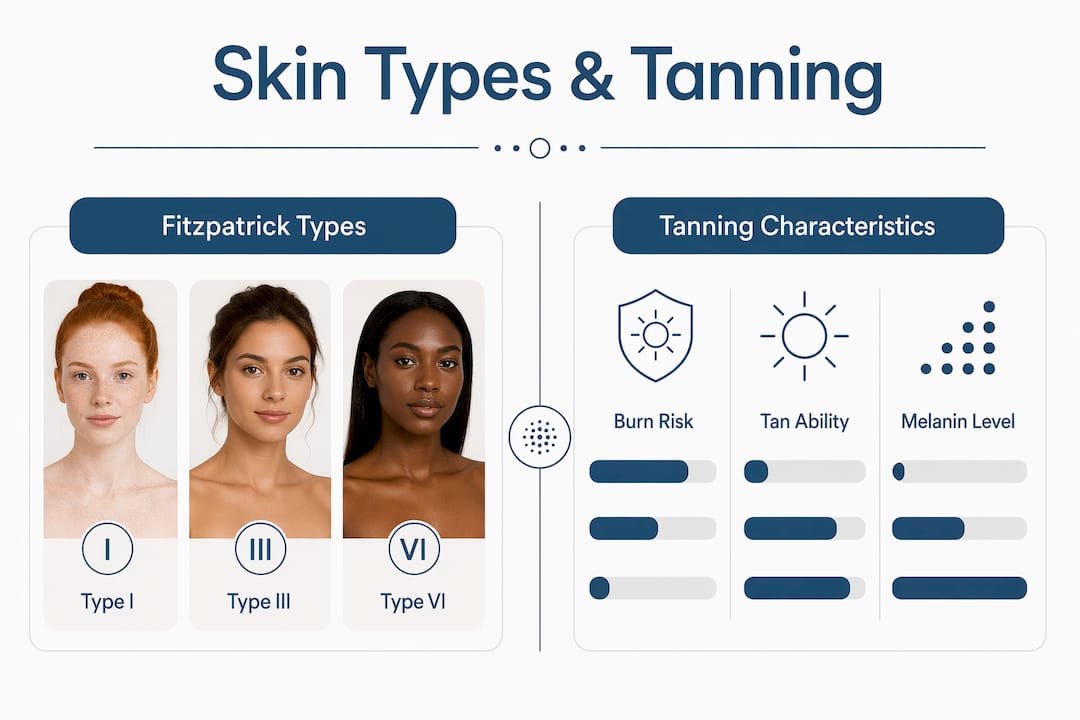
Fitzpatrick Type | Melanin Profile | Tanning Response | Burn Risk |
Type I | Very low eumelanin, high pheomelanin | Never tans | Always burns |
Type II | Low eumelanin, moderate pheomelanin | Rarely tans | Burns easily |
Type III | Moderate eumelanin | Tans gradually | Burns sometimes |
Type IV | Higher eumelanin | Tans well | Rarely burns |
Type V | High eumelanin | Tans deeply | Very rarely burns |
Type VI | Very high eumelanin | Tans very deeply | Almost never burns |
Pheomelanin offers weaker UV protection than eumelanin and raises the risk of UV-induced DNA damage. This means Types I and II are not simply “bad tanners.” Their skin chemistry actively works against them when exposed to UV. Pushing for a tan with repeated UV exposure in these phototypes raises melanoma risk without producing proportional color.
Skin tone is not the only variable. Hormones also shift melanin production. Estrogen and progesterone stimulate melanocyte activity, which is why pregnancy and hormonal contraceptives can cause melasma, a condition of uneven pigmentation. Sun sensitivity and body chemistry are linked through these hormonal pathways in ways most people never consider.
Pro Tip: Knowing your Fitzpatrick type before tanning is not vanity. It is risk management. A Type II person who tans like a Type IV is not getting a better result. They are accumulating UV damage without the melanin to absorb it.
What skin surface chemistry does to sunless tanning
Sunless tanning works through an entirely different system. DHA does not interact with melanocytes at all. Instead, it reacts with free amino acids in the dead protein layer of the skin (the stratum corneum) through the Maillard reaction, the same browning chemistry that colors bread crusts and roasted coffee.
Maximal DHA color develops within 24 hours of application, with repeated use deepening the tone. The color produced is not melanin. It is a group of brown compounds called melanoidins. These are chemically distinct from melanin and behave differently over time.
Several skin surface factors determine how your DHA tan turns out:
Hydration: Dry skin has uneven protein distribution, which causes patchy color development
pH: Slightly acidic skin (pH 4–5.5) produces faster, more even color; alkaline skin slows the reaction
Amino acid availability: Higher concentrations of surface amino acids produce deeper color
Exfoliation status: Dead skin that is already flaking will shed the color unevenly and quickly
Application timing: Applying DHA to freshly washed, lightly moisturized skin improves uniformity
DHA concentration in products ranges from 1% to 20%. Most consumer products use 3%–5%. Higher concentrations produce faster, deeper color but increase the risk of orange undertones and uneven patches. The relationship between DHA concentration and color quality is not linear. More is not always better.
Pro Tip: Lightly exfoliate 24 hours before applying a DHA product, then apply a thin layer of moisturizer to dry areas like elbows and knees. This levels the skin surface chemistry and produces a more even result.
Skin hydration plays a central role in both DHA tanning and natural melanin production. Well-hydrated skin maintains a more consistent surface pH and protein distribution, which directly improves how evenly DHA color develops.
Common misconceptions about tanning and body chemistry
The biggest misunderstanding in tanning is treating the visible result as real-time feedback. It is not. UV tanning is delayed by 48–72 hours because it depends on gene expression and melanosome production. People who re-expose themselves before the first tan has fully developed risk a burn because their skin has not yet produced the melanin needed to absorb the next UV dose.
A second common error is assuming a DHA tan works like a melanin tan. The table below clarifies the key differences.
Factor | UV (melanin) tanning | Sunless (DHA) tanning |
Location in skin | Living melanocytes | Dead stratum corneum |
Chemistry | Melanogenesis cascade | Maillard reaction |
Color compound | Melanin | Melanoidins |
Time to develop | 48–72 hours | 24 hours |
Duration | Weeks (fades with cell turnover) | Days (fades with exfoliation) |
UV protection provided | Yes, partial | None |
Key risk | UV damage, sunburn | Oxidative stress with high DHA |
DHA-produced melanoidins are chemically distinct from melanin and provide no UV protection. Wearing a DHA tan in the sun without SPF is just as risky as going out with no tan at all.
Frequent use of high-concentration DHA can cause oxidative stress in the skin and may interfere with vitamin D synthesis. This does not mean sunless tanning is unsafe. It means concentration and frequency matter. Using a moderate-strength product two to three times per week is a different risk profile than daily application of a 15% formula.
Key Takeaways
Body chemistry governs tanning outcomes through two distinct systems: UV-triggered melanogenesis in living skin cells and DHA-driven Maillard reactions in dead surface proteins.
Point | Details |
UV tanning is delayed | A real tan takes 48–72 hours to appear; re-exposing too soon risks burns. |
Melanin type determines outcome | High eumelanin means better tanning; high pheomelanin means more burning and less color. |
DHA reacts with dead skin | Sunless tanning color is melanoidins, not melanin, and provides zero UV protection. |
Skin surface chemistry matters | Hydration, pH, and exfoliation status directly affect how evenly DHA color develops. |
Genetics set the baseline | MC1R variants and Fitzpatrick phototype determine how efficiently your body produces melanin. |
What working with skin chemistry has taught me about tanning
Most people approach tanning as a cosmetic goal and ignore the biology entirely. That is where things go wrong. After years of working with tanning products and skin chemistry, the clearest pattern is this: the people who get the best results are the ones who work with their skin type, not against it.
A Type II person chasing a Type V tan through repeated UV exposure is not tanning. They are accumulating DNA damage while their pheomelanin generates reactive oxygen species instead of absorbing UV. The tan they want is not accessible through that pathway. Their MC1R signaling simply does not support it at that depth.
Sunless tanning, when done correctly, is genuinely the smarter option for lighter phototypes. The chemistry is predictable. You control the depth by choosing the DHA concentration. You control the evenness by managing your skin surface before application. There is no delayed feedback loop, no burn risk, and no UV damage. The limitation is that it fades faster and provides no sun protection. That is a fair trade for most people.
The one thing I see people skip most often is pre-application skin prep. Hydration is not optional. Dry skin produces patchy, short-lived color because the protein distribution in the stratum corneum is uneven. A well-hydrated skin surface gives DHA a consistent substrate to react with. That single step changes the result more than switching to a higher-concentration product.
Tanning is a balance between aesthetics and skin health. Understanding your own chemistry is what makes that balance achievable.
— Nutan
Nutan’s approach to tanning that works with your body
Tanning patches offer a way to support your skin’s natural melanin pathways with minimal UV exposure or injections. Nutan’s Nu-Tan tanning patches are a transdermal, pain-free alternative designed to work gradually and safely with your body’s own chemistry.

Each patch delivers a melanin precursor through the skin at a controlled rate, supporting the same biological pathways that UV exposure activates, without the burn risk or DNA damage. The result is a natural-looking, gradual colour that builds over time. For readers who want a deeper or faster result, Nutan also offers a triple-strength patch option designed to boost pigmentation more quickly while staying within safe, natural biochemical limits. Simply apply, wait, and let your skin do the rest.
FAQ
What triggers melanin production in the skin?
UV radiation activates the p53 protein, which starts a signaling chain ending in tyrosinase enzyme activity and new melanin synthesis. This delayed tanning process takes 48–72 hours to produce visible colour.
Why do some people tan easily and others burn?
Tanning ability depends on your Fitzpatrick phototype and the ratio of eumelanin to pheomelanin in your skin. People with more eumelanin tan efficiently, while those with more pheomelanin burn more easily and produce less color per UV dose.
Does a DHA tan protect you from the sun?
No. DHA-produced melanoidins are chemically distinct from melanin and provide no UV protection. You still need SPF when outdoors, regardless of how dark your sunless tan appears.
How long does a sunless tan last?
A DHA tan typically lasts several days to about a week, fading as the dead skin cells in the stratum corneum naturally exfoliate. Regular moisturizing slows this process and extends the color.
Can hormones affect how well you tan?
Yes. Estrogen and progesterone stimulate melanocyte activity, which is why hormonal changes from pregnancy or contraceptives can alter pigmentation patterns and overall tanning response.
Recommended
Comments