

What is a legal tanning method? Your safe options explained

A legal tanning method is defined as any technique that complies with regulatory standards set by bodies such as the FDA, WHO, and the International League of Dermatological Societies (ILDS), allowing individuals to achieve a tan without breaching safety laws or causing undue harm. The distinction matters because not all tanning approaches carry the same legal standing or health profile. UV-based methods like sunbeds operate under strict device classifications, while newer approaches such as NuTan® transdermal tanning patches work by stimulating the skin’s own melanin production with over 70% less UV exposure than traditional methods. Understanding the difference between approved tanning methods and unregulated ones is the first step towards a safer, sun-kissed glow.
What is a legal tanning method and how is it regulated?
A legal tanning method is one that either complies with device safety regulations or uses cosmetically approved ingredients to alter skin colour without causing DNA damage. Regulatory bodies draw a clear line between methods that are permitted under law and those that are not. The FDA, WHO, and ILDS each publish guidance that shapes what is permissible in different countries and contexts.
The core distinction sits between UV-based tanning and non-UV tanning. UV-based methods, including outdoor sun tanning and tanning beds, are legal for adults in most countries but come with mandated safety requirements. Non-UV methods, such as professional spray tans and patch-based solutions, generally face fewer restrictions because they do not expose the skin to ionising radiation.
Legality alone does not guarantee safety. A method can be fully legal and still carry meaningful health risks, which is why understanding the regulatory context behind each option matters so much.
How do UV tanning methods fit within legal frameworks?
UV tanning is legal for adults in most countries, but it is one of the most regulated areas in cosmetic health. The FDA classifies tanning beds as Class II medical devices, placing them in the same moderate-risk category as powered wheelchairs and contact lenses. That classification means manufacturers must meet performance testing standards and apply specific safety labelling before their equipment reaches the market.
Age restrictions and legal warnings
Age restrictions on sunbed use vary considerably by location. Some US states ban under-18 use outright, while others require parental consent. The UK prohibits sunbed use for anyone under 18 under the Sunbeds (Regulation) Act 2010. These rules exist because tanning beds emit UV radiation at levels up to 15 times higher than direct midday sunlight. That intensity accelerates DNA damage in skin cells, raising the lifetime risk of melanoma.
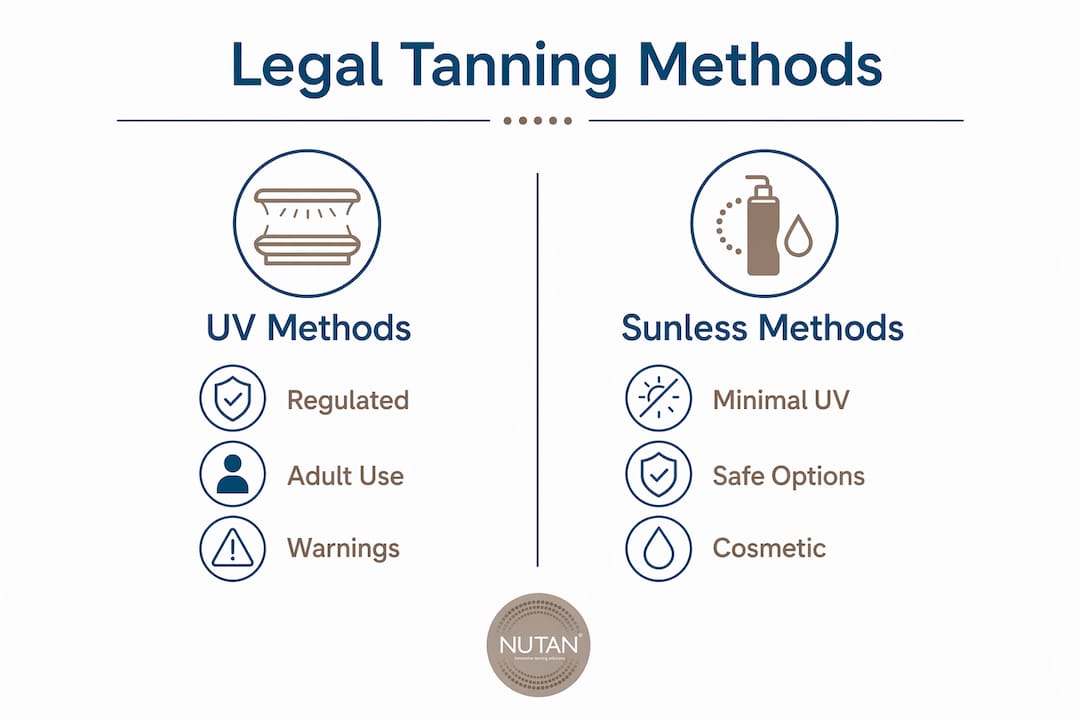
The FDA requires “black-box” warnings on all tanning bed equipment, advising against use by people under 18 and flagging the link between UV exposure and skin cancer. These warnings are not optional. Operators who fail to display them face regulatory penalties.
What the law does not ban
The FDA does not outright ban tanning beds for adults. Its regulatory approach favours controlled use over prohibition, relying on labelling, age restrictions, and device standards to manage risk. Outdoor sun tanning carries no legal restrictions at all for adults, though public health bodies consistently advise limiting unprotected exposure.
Key legal requirements for UV tanning in regulated markets:
Tanning beds must carry FDA-mandated safety labels and black-box warnings
Operators must comply with local age restriction laws
Equipment must pass performance testing before commercial use
Customers must be informed of UV exposure risks before each session
What are safer legal alternatives to UV tanning methods?
Sunless tanning is the broad industry term for any method that produces a tan-like colour change in the skin without UV radiation. These non-invasive tanning methods have grown significantly in popularity as people seek legally clear, lower-risk options for achieving a natural-looking glow.

Professional spray tans
Professional spray tans are a widely used sunless option. They are legal across most markets and do not require any UV exposure. Spray tans do not provide sun protection, so people who use them still need sunscreen when outdoors. They also colour only the outermost, dead skin layers, meaning the effect fades within 5–7 days as those cells shed naturally.
Sunless products can occasionally cause contact dermatitis in sensitive individuals, particularly when formulations contain fragrances or preservatives. A patch test before full application is a sensible precaution, especially for those with reactive skin.
Patch-based tanning: the minimal UV exposure approach
NuTan® tanning patches represent a different category entirely. Rather than colouring the skin’s surface, NuTan® patches work by stimulating the skin’s own biology. The patches contain NuTan MSH-ComplexB, a formulation derived from a natural source that acts in the same way as alpha-melanocyte-stimulating hormone (a-MSH). It binds to the Melanocortin 1 Receptor (MC1R) on melanocytes, the skin’s pigment-producing cells, and triggers a natural increase in melanin production.
The result is a genuine, natural-looking tan that does not rub or wash off. Because the skin is already primed to produce melanin, minimal UV exposure is all that is needed to complete the process. NuTan® patches require over 70% less UV exposure than conventional tanning methods to achieve a comparable result. That makes them one of the most legally straightforward and health-conscious options available.
Pro Tip: If you have fair or sensitive skin, patch-based tanning solutions that work with your skin’s natural biology are worth considering before committing to repeated UV sessions.
Safer legal alternatives at a glance:
Professional spray tans: legal, no UV, surface-level colour change, fades in 5–7 days
NuTan® transdermal patches: legal, stimulates natural melanin production, requires over 70% less UV exposure, tan does not wash off
Gradual tanning moisturisers: legal, surface-level colour, no UV required
How to tan legally and safely while protecting your skin
Tanning legally and safely requires more than simply choosing a permitted method. It means using that method correctly, respecting your skin’s limits, and maintaining skin health throughout the process.
Choose a method that complies with local law. If you are under 18, sunbeds are illegal in the UK and many US states. Opt for a non-UV method that carries no age restriction.
Limit UV exposure deliberately. Even when using a method that reduces UV dependency, such as NuTan® patches, keep any sun exposure brief and within safe daily limits. The goal is to work with your skin, not against it.
Apply sunscreen during any outdoor exposure. Sunless tanning products, including spray tans, provide no UV protection. Always use a broad-spectrum SPF 30 or higher when spending time outdoors.
Keep skin well hydrated. Hydrated skin holds a tan more evenly and for longer. Use a fragrance-free moisturiser daily, particularly after sun exposure or patch use.
Perform a patch test before trying new products. Contact dermatitis from preservatives and fragrances in tanning products is a documented risk. Testing a small area first protects against unexpected reactions.
Avoid unregulated tanning injections. Peptide injections sold outside of medical supervision are not approved by the FDA, MHRA, or equivalent bodies. They carry serious health risks and are illegal to supply in the UK.
Pro Tip: Pairing NuTan® patches with short, controlled periods of natural sunlight gives your skin everything it needs to produce a deep, lasting tan without the prolonged UV exposure that raises cancer risk.
How do legal tanning regulations vary globally?
Tanning regulation is far from uniform. Only 43.9% of countries have legal instruments specifically controlling cosmetic tanning bed use. That means the majority of nations rely on general consumer safety laws or voluntary industry codes rather than dedicated tanning legislation.
The WHO and ILDS have both published guidance recommending restrictions on sunbed use, particularly for adolescents. Their recommendations have influenced legislation in Europe, Australia, and parts of North America, but uptake remains inconsistent globally.
Region | Legal status of tanning beds | Under-18 restrictions |
United Kingdom | Legal for adults | Banned under 18 (2010 Act) |
United States | Legal for adults (Class II device) | Varies by state |
Australia | Banned in all states | Full ban applies |
European Union | Legal in most member states | Varies by country |
Rest of world | Largely unregulated | Minimal or no restrictions |
The trend in 2026 is towards stricter regulation. Australia banned commercial tanning beds entirely. Several European nations have tightened age restrictions and introduced mandatory operator training. The regulatory landscape is moving in one direction: greater control, not less. For people seeking a legally clear path to a golden glow, non-UV and minimal UV exposure methods are increasingly the most straightforward choice. Checking safety in aesthetics guidance from qualified practitioners is a sound step before booking any professional tanning treatment.
Key takeaways
Legal tanning methods are defined by regulatory compliance, and the safest approved options are those that minimise or eliminate UV exposure entirely.
Point | Details |
Legal does not mean risk-free | Tanning beds are legal for adults but classified as moderate-risk medical devices with mandatory safety warnings. |
Age restrictions are law | The UK bans sunbed use under 18; US rules vary by state, making compliance a legal obligation. |
Non-UV methods are the clearest option | Spray tans and patch-based solutions carry fewer legal restrictions and avoid UV-related DNA damage. |
NuTan® patches reduce UV dependency | NuTan® patches stimulate natural melanin production, requiring over 70% less UV exposure than conventional tanning. |
Global regulation is tightening | Only 43.9% of countries have dedicated tanning laws, but the trend is towards stricter controls worldwide. |
Why I believe the tanning conversation needs to change
Most people asking what a legal tanning method is are really asking something deeper: “How do I get a tan without damaging my skin?” The legal question is a proxy for a health question, and that matters.
The tanning industry has spent decades treating UV exposure as an unavoidable part of the process. That assumption is now outdated. The science behind melanocortin receptor activation shows that the skin can be encouraged to produce its own melanin with a fraction of the UV stimulus that traditional methods require. NuTan® patches are built on exactly that principle.
What I find most encouraging is that people are becoming more discerning. They want to know what is in a product, how it works, and whether it is legally and medically sound. That is the right instinct. Unregulated tanning injections, which are illegal to supply in the UK, remain a genuine risk for people who prioritise results over safety. The patch-based approach sidesteps that risk entirely while delivering results that are genuinely natural, because they come from your own skin’s biology.
My honest advice: prioritise methods that work with your skin rather than forcing a result through excessive UV. A tan achieved through your own melanocytes, with minimal UV exposure, is not only safer. It looks better and lasts longer too.
— NuTan®
NuTan® patches: a legal, minimal UV exposure tanning solution
For those who want a natural-looking tan without the risks of prolonged UV exposure, NuTan® offers a genuinely different approach.
NuTan® transdermal tanning patches contain NuTan MSH-ComplexB, a naturally sourced formulation that activates the MC1R receptor on your skin’s melanocytes, triggering your body’s own tanning process. The result is a real tan that does not rub or wash off, achieved with over 70% less UV exposure than conventional methods. NuTan® ships worldwide, making it accessible wherever you are. The NuTan® Triple Strength patches are the most popular choice for those seeking a deeper, longer-lasting result through a safe, legally compliant method.
FAQ
What is a legal tanning method?
A legal tanning method is any technique that complies with the safety regulations set by bodies such as the FDA, WHO, or national health authorities, including regulated sunbed use for adults and approved sunless tanning options.
Are tanning beds legal in the UK?
Tanning beds are legal for adults in the UK but are banned for anyone under 18 under the Sunbeds (Regulation) Act 2010. Operators must comply with safety and age-verification requirements.
What are the safest legal tanning options available?
The safest approved tanning methods are those that avoid or minimise UV exposure, including professional spray tans and patch-based solutions such as NuTan® patches, which stimulate natural melanin production with over 70% less UV than traditional tanning.
Do sunless tanning methods provide sun protection?
Sunless tanning methods do not provide any UV protection. People using spray tans or tanning patches still need to apply a broad-spectrum sunscreen when spending time outdoors.
Are tanning injections legal in the UK?
Tanning injections, including unregulated peptide products, are illegal to supply in the UK and are not approved by the MHRA or FDA. They carry serious health risks and fall outside the definition of permissible tanning practices.
Recommended
Comments