

Less Sun tanning: how NuTan® patches give you a real, natural glow
- Aug 13
- 9 min read

NuTan® transdermal tanning patches produce a genuine, melanin-based tan by activating the MC1R receptor on your skin’s pigment cells, requiring significantly less UV exposure than conventional tanning methods. The tan is biologically real, does not rub off, and does not wash away. Before ordering, run a quick suitability check: no personal or family history of melanoma, no pregnancy, no active skin lesions under investigation. If you are clear on all three, you can order NuTan® patches directly online with worldwide delivery.
Key takeaways
Point | Details |
How the tan is produced | b-MSH binds MC1R, raises cAMP, drives tyrosinase activity and eumelanin synthesis. |
UV reduction | NuTan® patches require significantly less UV than standard tanning to achieve a comparable result. |
Who should screen first | Anyone with a melanoma history, pregnancy, or RHC MC1R variants should consult a GP before use. |
Side effect monitoring | Monitor patch sites for contact dermatitis; use ABCDE mole checks throughout your course. |
NuTan® options | Single box (10 patches), two-box kit (20 patches), and triple-strength available online with worldwide delivery. |
Table of Contents
What is Less sun tanning in this article, and what will you learn?
In this article, “Less sun tanning” means one specific thing: using a transdermal patch that delivers a biologically active beta-melanocyte-stimulating hormone (b-MSH) formulation to trigger your skin’s own melanin production. NuTan® patches work by kickstarting the body’s natural tanning process, not by staining the skin’s surface. This is a fundamentally different approach from topical wipe-on products, which are outside the scope of this article entirely.
Here is what this guide covers:
How NuTan® patches work at the cellular level (MC1R, cAMP, melanin synthesis)
The safety profile and clinical evidence behind α-MSH analogues
Who is a good candidate and who should not use the patches
Step-by-step usage guidance and realistic timelines
Side effects to watch for and when to seek medical advice
Where to buy in the UK, what to check, and how to get support
How do NuTan® patches actually trigger a tan?
NuTan® patches deliver the brand’s proprietary NuTan MSH-ComplexB, a b-MSH formulation derived from a natural source, transdermally into the skin. Once absorbed, it binds to and activates the Melanocortin 1 Receptor (MC1R) on the surface of melanocytes, the pigment-producing cells in your skin.
The MC1R signalling cascade
When the b-MSH analogue binds MC1R, it raises intracellular cyclic AMP (cAMP). Elevated cAMP activates protein kinase A (PKA), which in turn phosphorylates the transcription factor CREB. CREB then up-regulates MITF (microphthalmia-associated transcription factor), which drives expression of tyrosinase, the key enzyme in melanin synthesis. The result is increased production of eumelanin, the dark, photoprotective pigment. Melanosomes carrying this eumelanin are then transferred to surrounding keratinocytes, forming the protective cap above cell nuclei that gives skin its darker tone. This entire pathway is well described in foundational melanin biochemistry research.
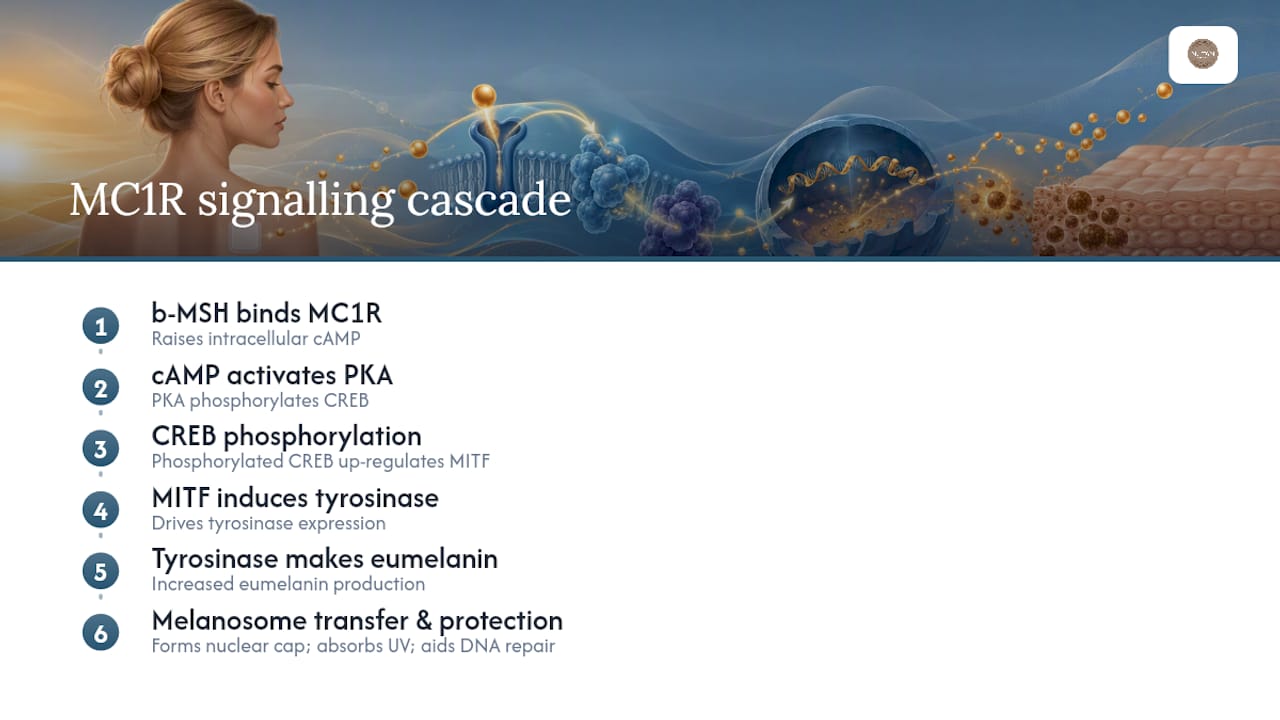
Eumelanin is not merely cosmetic. It absorbs and attenuates UV radiation and supports nucleotide excision repair of UV-damaged DNA, a dual photoprotective mechanism confirmed in peer-reviewed melanocortin signalling research.
How the patch delivers the active
Transdermal delivery works best for actives that can cross the stratum corneum. Research on transdermal drug delivery systems notes that low-molecular-weight, stable actives are best suited to patch formats, which avoid first-pass metabolism and allow controlled, sustained release. NuTan®'s formulation is designed to achieve this delivery through the skin barrier.
Pro Tip: People with common loss-of-function MC1R variants, particularly the RHC alleles associated with red hair (such as R151C and R160W), may see a reduced response. These variants attenuate receptor signalling, meaning the patch has less functional receptor to activate. If you have naturally red hair and very fair skin, manage expectations and consider consulting a GP before purchasing.
MC1R activation does more than darken skin. Research shows it also enhances nucleotide excision repair via PKA-dependent ATR phosphorylation, offering a layer of cellular protection that goes beyond pigment alone. This dual mechanism is one of the most compelling aspects of the melanocortin pathway for anyone thinking seriously about UV safety.
What does the clinical evidence say about safety?
Evidence supports that α-MSH analogues can increase pigmentation and may reduce UV photodamage, but the safety picture depends on the molecule, the dose, and the delivery route. NuTan® uses a transdermal b-MSH formulation rather than a systemic injection, which is a meaningful distinction.
UV radiation is classified by the International Agency for Research on Cancer as a Group 1 carcinogen, and studies indicate that the majority of somatic mutations in melanoma carry UV-signature base changes. Reducing UV exposure while still achieving a tan is therefore a genuinely worthwhile goal, not just a marketing claim.
Research on α-MSH analogues confirms they stimulate melanogenesis and can reduce UV-induced DNA damage in experimental and clinical settings. Selectivity matters: more MC1R-selective peptides tend to carry fewer off-target effects than older, less selective analogues. Studies with MSH and its analogues have shown enhanced DNA repair markers and reduced thymine dimer formation, supporting a benefit beyond cosmetic pigmentation.
Reported adverse effects with systemic melanocortin agents (such as afamelanotide given subcutaneously) include nausea, flushing, and diffuse hyperpigmentation beyond the treated area. Transdermal patch-specific concerns include contact dermatitis, local skin irritation, and adhesive sensitisation.
⚠️ Safety warning: Consult your GP before using NuTan® patches if you have a personal or family history of melanoma, a history of non-melanoma skin cancer on sun-exposed sites, are pregnant or breastfeeding, are immunosuppressed, or have any undiagnosed skin lesions. The long-term effect of exogenous MC1R activation on melanoma risk modification is not yet conclusively established. This is general information, not a substitute for professional medical advice.
Evidence area | Key finding | Source |
UV carcinogenesis | IARC Group 1 carcinogen; majority of melanoma mutations are UV-signature | PMC5315647 |
α-MSH analogues and pigmentation | Stimulate MC1R, raise cAMP, increase tyrosinase and melanin | PMC6163888 |
DNA repair enhancement | MSH analogues reduce UV photoproducts and enhance nucleotide excision repair | PMC2862104 |
Transdermal patch risks | Contact dermatitis and adhesive irritation are common TDDS adverse effects | NBK556035 |
Who benefits most, and who should avoid NuTan® patches?
Ideal candidates
Fair to medium skin types wanting a melanin-based, natural-looking tan
People who want to reduce UV exposure significantly compared with sunbathing or sunbed use
Those who prefer a patch format over injections or topical staining products
Adults in good general health with no relevant skin cancer history
Who should not use NuTan® patches
Personal or family history of melanoma
History of non-melanoma skin cancer on sun-exposed areas
Known loss-of-function MC1R genotype (red-hair variants such as R151C, R160W), as cellular research confirms attenuated signalling in these variants
Pregnancy or breastfeeding
Children below the manufacturer’s stated age limit
Immunosuppressive medication or active immunological conditions
Undiagnosed or changing skin lesions
When speaking to your GP, mention the active ingredient (b-MSH analogue, NuTan MSH-ComplexB), the intended application schedule, and your full skin history, including any previous mole removals or atypical lesion diagnoses.
How do you use NuTan® patches correctly?
Follow the manufacturer’s schedule as stated on your product packaging. Patches work in combination with minimal, controlled UV exposure — you do not need prolonged sun sessions. A short period of natural daylight or equivalent is sufficient to activate the melanin response once the patch is working.
[
Prepare your skin
Clean and dry the application site. Avoid broken, irritated, or recently shaved skin. Rotate sites with each application to reduce the risk of localised irritation.
Apply the patch
Peel and press firmly onto the chosen site. Smooth from the centre outward to remove air pockets. Leave in place for the duration stated in your instructions.
What to expect over time
Milestone | Approximate timeframe |
First subtle pigment change | Days 7–14 |
Noticeable deeper colour | Weeks 3–4 |
Maintenance phase | Ongoing with continued use per schedule |
Timelines vary by skin type, MC1R function, and UV exposure level. Individuals with RHC variants may see slower or lighter results.
Troubleshooting: If the patch lifts, press the edges back down or replace it. Uneven pigment usually reflects inconsistent UV exposure rather than a patch failure. A low response after four weeks may indicate a loss-of-function MC1R variant. Contact NuTan® support or your GP if you experience persistent irritation or unexpected skin changes.
Pro Tip: Avoid prolonged, unprotected sun exposure during the first 48 hours after applying a new patch, particularly if you notice any local redness. Apply SPF to exposed skin as standard practice throughout your course.
What side effects should you watch for?
Common local reactions
Redness or mild itch at the patch site
Slight peeling or dryness around the adhesive edge
Temporary skin marking from the patch outline
These typically resolve within an hour or two of removing the patch. Adhesive-related contact dermatitis is the most frequently reported issue with transdermal systems generally, and monitoring for it should be routine.
Systemic reactions to be aware of
Systemic melanocortin agents have been associated with nausea, flushing, and pigmentation changes beyond the application area. If you notice any of these with NuTan® patches, stop use and consult a GP.
When to seek urgent medical review
A mole that changes shape, colour, or size rapidly
Persistent blistering or open sores at or near the patch site
Severe systemic symptoms (persistent nausea, widespread skin changes, difficulty breathing)
Use the ABCDE mnemonic to monitor moles: Asymmetry, Border irregularity, Colour variation, Diameter over 6mm, Evolving appearance. Photograph baseline moles before starting and check monthly. Stop patch use immediately if any lesion changes.
Buying NuTan® patches in the UK: what to check first
NuTan® patches are sold direct-to-consumer online, with worldwide delivery including to UK addresses. Before completing an order, confirm the following:
Buying checklist | What to verify |
Active ingredient | NuTan MSH-ComplexB (b-MSH formulation) listed on packaging |
A Genuine NuTan® Product | Buy direct from Nutan.net or nu-tan.net |
Instructions for use | Included in box; read fully before first application |
Returns and support | Confirm returns policy and customer support contact before ordering |
NuTan® offers three product options: a single box of 10 patches for a standard first course, a two-box kit of 20 patches suited to a multi-week programme, and a triple-strength option for experienced users seeking a stronger effect. UK buyers should note that customs and VAT may apply to orders dispatched from outside the UK; check the product page for current shipping and duty information. Keep your original packaging throughout your course as it contains safety and dosage information.
For a deeper look at how NuTan® compares with injection-based approaches, the safer alternative to melanotan injections guide covers the key differences clearly.
A note on balancing aesthetics and safety
Wanting a sun-kissed glow is entirely understandable, and NuTan® was developed precisely for people who want that result without the UV burden that traditional tanning carries. The science behind MC1R activation is real and well-supported, and the transdermal patch format is a considered, needle-free approach to delivering it. That said, no tanning method sits outside the need for personal medical judgement. If you have any doubt about your suitability, a brief conversation with your GP costs nothing and protects everything. NuTan® support is also available for product-specific questions.
NuTan® patches: choose your option and order today
NuTan® gives you a biologically real, natural tan with significantly less UV exposure than conventional tanning, without needles, without staining, and without the tan washing off. The single box of 10 patches is the ideal starting point for first-time users. If you are planning a multi-week course, the two-box kit of 20 patches offers better value and continuity. Experienced users wanting a stronger effect can opt for the triple-strength patches. All orders come with full instructions, worldwide shipping, and access to NuTan® customer support for any product or safety questions. Visit the product page to confirm current shipping times to your UK address, review the returns policy, and place your order.
Sources
FAQ
What makes NuTan® patches different from topical tanning products?
NuTan® patches deliver a b-MSH formulation transdermally to activate MC1R and stimulate your skin’s own melanin production. The resulting tan is biologically real, not a surface stain, so it does not rub or wash off.
How much UV exposure do you need when using NuTan® patches?
A short period of natural daylight is sufficient; prolonged sunbathing sessions are not needed or recommended.
Can anyone use NuTan® patches safely?
Most healthy adults can use them, but people with a personal or family history of melanoma, pregnancy, or known loss-of-function MC1R variants (red-hair alleles) should consult a GP before starting. Full contraindications are listed in the product instructions.
How long before you see results with NuTan® patches?
A first subtle pigment change typically appears within 7–14 days, with a noticeably deeper colour developing by weeks 3–4, depending on skin type, MC1R function, and UV exposure level.
Where can you buy NuTan® patches in the UK?
NuTan® patches are available direct online at nutan.net, with worldwide delivery. UK buyers should check the product page for current shipping times and any applicable customs or VAT information.
Recommended
Comments