

UV index tanning: safer session times and low-UV alternatives
- Aug 17
- 11 min read
The UV Index is a public-health safety metric-index), not a tanning guide. Any visible tan is a sign that your skin has sustained UV-induced DNA stress. That said, if you choose to tan outdoors, understanding the UV Index helps you limit harm. Here is what to do at each level:
UV 0–2 (low): Brief unprotected exposure is low risk for most skin types. SPF is still advisable for fair skin or extended time outdoors.
UV 3–6 (moderate to high): Apply SPF 30+ before going out, seek shade after short sessions, and avoid the midday window (roughly 10 AM–4 PM). Tanning is possible but burn risk rises quickly.
UV 7 and above (very high to extreme): Protective clothing, SPF 50+, and shade are non-negotiable. Tanning sessions should be very brief or avoided entirely. The US EPA and Skin Cancer Foundation both recommend full protection at these levels.
Key takeaways
The UV Index measures sunburn risk, not tanning potential. Any visible tan from UV exposure signals skin damage, and the safest approach is always to minimise UV dose while using SPF 30+ protection.
Point | Details |
UV Index is a safety tool | The WHO and EPA designed it to indicate burn risk, not to guide tanning sessions. |
UV 3–5 is the practical tanning range | Visible tanning is possible at moderate UV, but burn risk rises quickly, especially for Fitzpatrick Types I–II. |
Apply the 0.5–0.75 safety factor | Multiply your estimated burn time by 0.5–0.75 to set a conservative session ceiling. |
No UV tan is risk-free | A base tan offers only negligible SPF equivalent; cumulative UV damage is the primary driver of photoageing and skin cancer. |
NuTan® patches reduce UV burden | The brand states NuTan® patches require over 70% less UV exposure than standard methods to achieve a comparable natural tan. |
Table of Contents
What each UV Index band actually means for your skin
The UV Index is an internationally standardised scale, developed under WHO and EPA guidelines, that measures the intensity of ultraviolet radiation reaching the Earth’s surface at a given moment. A higher number means UV photons are arriving faster, compressing the time before skin damage begins. The scale runs from 0 to 11+, divided into five risk bands.
UV Index band | Risk level | Minimum protection |
0–2 | Low | No action needed for most; SPF advisable for fair skin |
3–5 | Moderate | SPF 30+, hat, seek shade at midday |
6–7 | High | SPF 30–50+, protective clothing, limit midday exposure |
8–10 | Very high | SPF 50+, cover up, avoid 10 AM–4 PM sun |
11+ | Extreme | Stay indoors at peak hours; full cover essential |
The shadow rule is a quick on-the-spot check: if your shadow is shorter than your height, the UV is high enough to burn. Seek shade immediately. The EPA recommends this as a practical field test when you cannot check a forecast.
Per-band protection checklist:
0–2: Sunglasses recommended; SPF optional for darker skin types, advisable for Fitzpatrick I–II.
3–5: SPF 30+ on all exposed skin; wide-brimmed hat; limit sessions to short windows before 10 AM or after 4 PM.
6–7: SPF 30–50+; UV-protective clothing on shoulders and chest; no unprotected midday exposure.
8–10: SPF 50+; long sleeves; sunglasses with UV400 rating; reapply sunscreen every two hours per AAD guidance.
11+: Avoid direct sun between 10 AM and 4 PM; if outdoors, full cover and SPF 50+ are the minimum.
How the UV Index changes your tanning and burn time
Two separate biological processes produce a tan, and both signal that UV radiation has stressed your skin. Medical News Today explains that immediate pigment darkening happens within minutes: UVA oxidises existing melanin, producing a temporary darkening that fades quickly. Delayed melanin production, driven mainly by UVB, follows over 48–72 hours as melanocytes synthesise new pigment in response to DNA damage. Both responses are the skin’s protective reaction, not a sign of health.
The practical consequence: a higher UV Index shortens the time before redness appears, leaving a narrower window between “starting to tan” and “starting to burn.” Weather Story’s evidence summary illustrates this with sample estimates. At UV 6, fair skin (Fitzpatrick Type I–II) may begin to redden in roughly 22 minutes. At UV 11+, that window shrinks considerably. The table below gives conservative estimates for guidance only; individual variation is significant.
Estimated minutes to first redness (conservative estimates — not medical advice)
These figures are illustrative estimates drawn from published UV exposure modelling. Use them as a starting point, not a prescription. An evidence-based exposure formula combines your UV Index reading, your Fitzpatrick type, and a conservative safety factor (typically 0.5–0.75 of the estimated burn time) to set a session ceiling. Calculators from Cancer Research UK and the WHO UV Index tool allow you to personalise these estimates further.
Practical tanning guidance by UV band: pacing, SPF, and when to stop
Turning the data into a usable plan means thinking in short, incremental sessions rather than one long exposure. Dermatology commentary from Olansky Dermatology is clear: chasing higher UV numbers to tan faster is riskier than it sounds, because the burn window compresses faster than the tan deepens.
Per-band session guidance:
UV 3–5 (moderate): Sessions of 15–20 minutes maximum for Fitzpatrick I–II; up to 30 minutes for Types III–IV. SPF 30+ applied 20 minutes before going out. Avoid 11 AM–3 PM. Shade breaks every 10 minutes.
UV 6–7 (high): Cap sessions at 10–15 minutes for fair skin; 20 minutes for medium tones. SPF 30–50+. No unprotected midday exposure. Reapply sunscreen if you stay out longer.
UV 8–10 (very high): Sessions should not exceed 10 minutes for any skin type seeking a tan. SPF 50+ is the baseline. Protective clothing on the shoulders and décolletage. Consider a non-UV alternative on these days.
UV 11+ (extreme): Outdoor tanning is not advisable. The burn window is too narrow for safe incremental exposure.
Pacing over days matters as much as any single session. Building colour gradually over five to seven days with short exposures is far less damaging than a single long session, because it allows the skin’s natural melanin response to develop without overwhelming its repair capacity.
Pro Tip: Apply a broad-spectrum SPF 30+ to your face every day regardless of session length. Facial skin is thinner and more prone to photoageing, and most people underestimate how much incidental UV it accumulates.
When to stop immediately: redness appearing during a session, skin feeling warm or tight, unusual soreness, or any stinging sensation. If blistering develops, or if you experience fever, chills, or nausea after sun exposure, seek clinical advice promptly. People with a personal or family history of skin cancer, those on photosensitising medications, and anyone with a large number of moles should consult a dermatologist before any planned UV tanning. A combined tanning and skincare routine that includes post-session moisturising and gentle exfoliation also helps maintain skin health between sessions.
How to estimate your safe exposure time step by step
A simple algorithm gives you a conservative session ceiling without needing specialist equipment. Follow these steps each time conditions change, because UV intensity varies with season, altitude, cloud cover, and time of day.
Check the current UV Index for your location using a weather app, the NIVEA UV guide, or your national meteorological service. Note the peak UV time (usually 11 AM–3 PM in summer).
Identify your Fitzpatrick skin type using the standard scale (I–VI). If unsure, err toward the lower number (fairer type) for safety.
Find your estimated burn time from the table above or from an online UV exposure calculator. Use the figure for your skin type at the current UV level.
Apply a safety factor of 0.5–0.75. Multiply your estimated burn time by 0.5 for a conservative limit, or 0.75 if you have built some tolerance over several days. Weather Story’s evidence summary recommends this approach for personalised, lower-risk estimates.
Set a timer before going out. When it sounds, move into shade regardless of how your skin feels. Redness often appears 30–60 minutes after the damage has already occurred.
Re-check the shadow rule before extending any session: if your shadow is shorter than you are, the UV is high enough to burn.
Reapply SPF 30+ if you remain outdoors, and repeat the timer cycle. Do not assume the first application lasts all day.
Daily UV variation is real. A UV 4 morning can become a UV 8 afternoon in summer. Check the forecast at the start of each session, not just once in the morning. For a skin-tone-specific guide to session planning, the NuTan® resource library covers how different complexions respond to incremental UV exposure.
Why there is no truly safe UV tan: harms and how to spot early sunburn
Any tan produced by UV radiation is evidence of skin damage. Medical News Today states this plainly: the pigment change is the skin’s response to DNA stress, not a sign of wellness. The American Cancer Society links cumulative UV exposure to a range of serious long-term harms.
Documented harms from UV tanning:
Sunburn: acute inflammation, pain, and peeling; severe burns increase lifetime skin cancer risk.
Photoageing: accelerated wrinkling, loss of elasticity, and uneven pigmentation from repeated UVA exposure.
Hyperpigmentation: dark spots and uneven tone that can persist for months or years.
Actinic keratoses: rough, scaly patches that are pre-cancerous lesions requiring clinical monitoring.
Skin cancer: including basal cell carcinoma, squamous cell carcinoma, and melanoma, all linked to cumulative UV damage.
Eye damage: UV exposure without adequate eyewear raises the risk of cataracts and macular degeneration.
A “base tan” is not meaningful sun protection. Evidence summaries note that a tan provides only negligible SPF equivalent, roughly comparable to SPF 3. It does not replace sunscreen and should never be treated as a protective measure.
Cumulative damage is the key concern. Each UV session adds to a lifetime total. The skin does not reset between summers. Photoageing and cancer risk accumulate quietly over years, which is why dermatologists emphasise that there is no safe threshold for UV tanning, only varying degrees of risk.
Recognising early sunburn: skin that feels warm, looks pink, or feels tight during or shortly after exposure is already burning. Move into shade, apply cool (not cold) water or a damp cloth, and use a fragrance-free moisturiser. For post-exposure care and recovery products, The Re-gen Store’s sunburn relief range offers targeted skin recovery options. Seek medical attention if blistering appears, or if systemic symptoms such as fever, chills, or dizziness develop.
Harm-reduction options and non-UV alternatives, including NuTan® patches
If the goal is a natural-looking tan with less UV exposure, several categories of alternatives exist. They differ significantly in how they work, how long results last, and what risks they carry.
Spray tanning booths: apply a fine mist to the skin surface; results last several days but fade as skin sheds. No UV involved. Colour is a surface effect, not a melanin response.
Transdermal tanning patches: work differently from surface applications. NuTan® patches deliver a beta-melanocyte-stimulating hormone (b-MSH) complex transdermally, binding to the Melanocortin 1 Receptor (MC1R) on melanocytes and triggering the skin’s own pigment-production pathway. The result is a natural melanin-based tan, not a surface stain. The tan does not rub or wash off.
No-UV options: for those who want colour with zero UV, spray tanning and booth tanning remain the primary routes.
NuTan® transdermal tanning patches are positioned as a harm-reduction tanning option. Because the patches stimulate the skin’s natural melanin pathway via MC1R activation, the tan develops as genuine pigment rather than a surface colour. This means minimal UV is still involved, but at a substantially lower dose than lying in the sun at UV 6–8 for extended sessions.
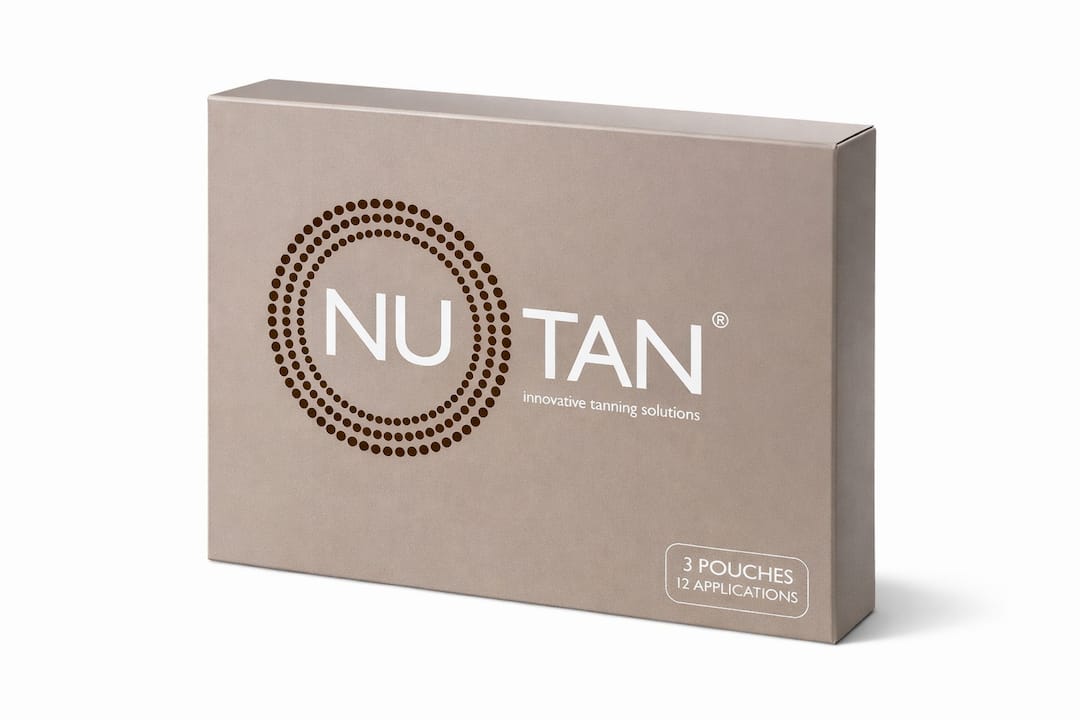
NuTan® patches work by activating your skin’s own tanning biology. The b-MSH formula in the NuTan MSH-ComplexB binds to MC1R receptors on melanocytes, triggering natural pigment production. The brand states this requires over 70% less UV exposure than standard tanning methods to achieve a similar-looking result — making it a lower-UV option for those who want a genuine, natural-looking tan.
People with medical risk factors, those on photosensitising medications, or anyone with a history of skin cancer should consult a clinician before using any tanning method, including transdermal patches. For a broader comparison of legal and safe tanning methods, the NuTan® resource library covers the full range of options with transparent safety notes.
A measured perspective on safe tanning choices
The honest position on UV tanning is this: the UV Index tells you how quickly you can damage your skin, not how efficiently you can tan. Using it as a tanning guide is a bit like reading a speed camera warning as a suggestion for how fast to drive. The information is useful for harm reduction, not optimisation.
What actually works for most people who want a sun-kissed glow without significant risk is a combination of short, well-timed UV sessions at moderate UV levels (3–5), consistent SPF 30+ use, and a realistic acceptance that the tan will be modest. For those who want more colour with less UV stress, a lower-UV approach using NuTan® patches is a genuinely different route: the skin produces real melanin, the result lasts, and the UV burden is substantially reduced.
The conventional wisdom that a “healthy tan” exists is the piece worth challenging. There is no UV tan that comes without a cost. The question is only how much cost you are willing to accept, and whether a lower-UV alternative might give you the result you want with less of it.
A lower-UV route to a natural-looking tan with NuTan® patches
For anyone who has read this far and decided that conventional UV tanning carries more risk than they want to accept, NuTan® transdermal tanning patches offer a concrete alternative. The patches deliver a natural b-MSH formula through the skin, activating the MC1R receptor on your melanocytes and triggering genuine pigment production. The tan that results is real melanin, not a surface stain, and it does not wash off.
The brand claims NuTan® patches reduce required UV exposure significantly compared to traditional tanning, potentially lowering UV dose needed for a similar tan. That means a brief, low-UV session rather than hours in the midday sun. Worldwide delivery is available, and the patches are a needle-free, pain-free option for those who want a natural glow without the UV burden of conventional tanning.
View the NuTan® tanning patches product page for full details, or explore the Triple Strength option for a stronger effect. As with any tanning method, consult a clinician if you have medical risk factors before starting.
[
Sources
The following sources were used in preparing this article. Each covers a distinct aspect of UV safety and tanning biology.
Check your local UV forecast each day before planning outdoor time, and follow official health guidance from your national health authority for the most current recommendations.
This article is general information, not a substitute for advice from a qualified doctor. Consult a qualified healthcare professional about your own circumstances before acting on anything here.
FAQ
What is the best UV index for tanning?
A UV Index of 3–5 (moderate) is the practical range for visible tanning for many skin types, as Weather Story’s evidence summary notes. Any level that produces a visible tan also produces skin damage, so shorter sessions with SPF 30+ are advisable even at moderate UV.
Is a UV index of 7 safe for tanning?
UV 7 is classified as “high” by the US EPA, and fair skin can begin to redden in as little as 15 minutes at this level. Brief, well-protected sessions are possible, but the burn window is narrow enough that most dermatologists recommend limiting unprotected exposure and using SPF 50+.
What UV level is enough to tan?
Tanning can occur from UV 3 upwards, though the speed and depth of colour depend on your Fitzpatrick skin type. Higher UV levels do not produce a better tan; they simply shorten the time before burning begins, which is why UV 3–5 is generally considered the most practical range for gradual, lower-risk colour.
Can you tan when the UV index is 1?
At UV 1–2 (low), tanning is very slow and burn risk is minimal for most skin types. Some gradual pigment change is possible with prolonged exposure, but the UV dose is low enough that meaningful colour development takes considerably longer than at moderate UV levels.
Do NuTan® patches mean you can skip sun exposure entirely?
A brief, low-UV session is still part of the process, but the UV burden is substantially reduced compared with standard outdoor tanning.
Recommended
Comments